Monkeying About With Ethics - Death at the Coulston Foundation
-darylp: November 4, 2001
I recently watched a program on chimpanzee research on the National
Geographic Channel, and was absolutely appalled at what I witnessed. Now I'm not some
virulent animal rights activist or anything, but damn if this didn't strike me as beyond
the pale. I believe that animals used for researching cures for diseases are vital, but
there is also a standard of humane treatment that must be adhered to.
The Coulston Foundation, a New Mexico research laboratory, is the only
research facility in the nation to be cited twice by the US Department of Agriculture for
violations of the Animal Welfare Act, for mistreatment and abuse of animals, including
several negligent chimpanzee deaths. The man in charge, Dr. Frederick Coulston, or
"Mein Furier" is this ugly wart of an old man, whose perspective on life is so
stunningly out-of-date, it's nothing short of astounding. It's like he time-warped out of
the 1950's and learned nothing from the intervening years. When describing his facility,
he said the following, "This is a sanctuary. What else would you call a sanctuary? A
prison is a human sanctuary. The inmates are housed and fed, but they work! They work,
don't they? I see no difference between that and our research facility's work with the
chimps." Apparently someone forgot to inform him that the chimps committed no crimes.
Indeed, Coulston violated the code of ethics of the very organization
which gave him an award in 1985, The Society of Toxicology, which states that
members shall, "Observe the spirit as well as the letter of the laws,
regulations, and ethical standards with regards to the welfare of humans and animals
involved in my experimental procedures."
Yet the government continues to work with this organization whose founder
has such a careless disregard for the value of life. The U.S. Department of Agriculture
has reported the following about the lab:
October 31, 1993
Federal Investigators found that Coulston Foundation failed to control the
temperature in a sheltered housing facility for primates, allowing the temperature in one
den to rise to 140 degrees and cause the death of three primates.
December 17, 1994
Federal Investigators found that Coulston Foundation failed to provide
water to 14 primates, resulting in the severe dehydration of all of them and the death of
four of them.
March 9, 1994
Federal Investigators found that Coulston Foundation failed to provide
adequate space for 37 primates.
June 6, 1994
Federal Investigators found that Coulston Foundation failed to provide
adequate space for 27 to 37 primates.
March 21, 1995
Federal Investigators found that Coulston Foundation failed to provide
adequate space for 27 to 37 primates.
March 28, 1998
Spanning a period of several months, Federal Investigators found that the
Coulston Foundation failed to:
Handle three sedated chimpanzees as carefully as possible in a manner
that did not cause behavioral stress, physical harm, and unnecessary discomfort
Provide adequate veterinary care to three chimpanzees in sedating them
as a group
Establish and maintain programs of adequate veterinary care, including
procedures and equipment for emergency care
Provide adequate pre-procedural care in accordance with current
established veterinary medical and nursing procedures, in that Coulston personnel failed
to ensure that the chimpanzees had fasted prior to sedation
Provide adequate pre-procedural care in accordance with current
established veterinary medical and nursing procedures in that Coulston personnel failed to
treat a chimpanzee for shock and stabilize its condition prior to surgical treatment
Provide adequate veterinary care to the chimpanzee, "Echo," in
that Coulston personnel undertook an extensive surgical procedure under inappropriate
conditions
Provide adequate post-procedural care in accordance with current
established veterinary medical and nursing procedures in that Coulston personnel failed to
adequately monitor the chimpanzee following surgery
Maintain primary enclosures for nonhuman primates in good repair so as
to protect the animals from injury and contain them
Store supplies of food for nonhuman primates in a manner that protects
them from spoilage, contamination and vermin infestation
Provide for the regular and frequent collection, removal, and disposal
of animal and food wastes, in a manner that minimizes contamination and disease risk. The
facility was not equipped with disposal facilities and drainage systems constructed and
operated so that animal wastes and water are rapidly eliminated and the animals may stay
dry
Construct surface materials of housing facilities in a manner that
allows for easy cleaning, sanitization and replacement
Clean and sanitize primary enclosure for nonhuman primates as required
Maintain structurally sound housing facilities and maintain them in good
repair so as to protect the animals from injury
Maintain sheltered housing facilities for nonhuman primates in a manner
that ensures that the animals were protected from temperature extremes, and to provide for
their health and well-being
Establish and maintain an effective program for the control of insects
and mammals that are pests so as to promote the well-being of the animals and reduce
contamination by pests
Keep the premises, including buildings, clean and in good repair in
order to protect the nonhuman primates from injury and to facilitate the required
husbandry practices
Adequately ventilate the facility for nonhuman primates
Make provisions for the regular and frequent collection, removal, and
disposal of animal and food wastes.
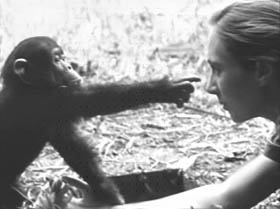 Jane
Goodall, the world's most well-known and preeminent primatologist, and a woman of gentle
grace, has specifically mentioned her concern with the activities of this particular lab
to government officials. In June 1997 the Air Force announced that it would give the
chimpanzees it used during the space program away via a public divestiture authorized by
Congress. Under the divestiture the chimpanzees would either be given to a research
laboratory, or be retired to a sanctuary. The Center for Captive Chimpanzee Care, which
counts world-renowned primatologist Jane Goodall among its board of directors, submitted a
proposal to retire the chimpanzees to a sanctuary but, the bid was rejected. Despite a
Congressional mandate that instructed the Air Force to award the chimps to an organization
that would best provide for their welfare, the Air Force awarded most of them to the
Coulston Foundation.
Jane
Goodall, the world's most well-known and preeminent primatologist, and a woman of gentle
grace, has specifically mentioned her concern with the activities of this particular lab
to government officials. In June 1997 the Air Force announced that it would give the
chimpanzees it used during the space program away via a public divestiture authorized by
Congress. Under the divestiture the chimpanzees would either be given to a research
laboratory, or be retired to a sanctuary. The Center for Captive Chimpanzee Care, which
counts world-renowned primatologist Jane Goodall among its board of directors, submitted a
proposal to retire the chimpanzees to a sanctuary but, the bid was rejected. Despite a
Congressional mandate that instructed the Air Force to award the chimps to an organization
that would best provide for their welfare, the Air Force awarded most of them to the
Coulston Foundation.
With typical journalistic
irresponsibility, this merited the most minimal blip on the news media radar, as they were
much too absorbed with who Clinton happened to be having consentual sex with that day.
You'd think it would have merited SOME notice, considering the fact that no less than
eleven astronauts spoke out against the decision. This group included astronauts Buzz
Aldrin, Scott Carpenter, Gerald Carr, Eugene Ceman, Gordon Cooper, Walter Cunningham,
Michael Collins, Jack Lousma, James Lovell, James McDivitt and Edgar Mitchell. Being
compassionate men of honor, they offered their support to peacefully retire the U.S. Air
Force chimpanzees. They endorsed a multimillion dollar plan to relocate the chimps to a
sanctuary. In the end, after a year-long legal battle, they were only able to save 21. The
Coulston Foundation by contrast, obtained 111.
I would encourage you to voice your
displeasure with the government's continual association with the Coulston Foundation by
writing your representatives. I would also recomend you give your generous support to Jane
Goodall's conservation efforts. You can reach her by clicking the icon below:

---------------------------
UPDATE
-heartsutra: November 6, 2001
After reading darylp's posting about
the mistreatment of chimpanzees at the Coulston labs, I began to investigate the issue
further, and came across this very powerful essay. I encourage everyone to read it and
become active in animal protection.
A Barrel of Monkey Business
-by Jennifer Winston
Each year in the United States, an
estimated 70 million animals are maimed, blinded, scalded, force-fed chemicals,
genetically manipulated, and otherwise hurt and killed in the name of science, by private
institutions, household product and cosmetics companies, government agencies, educational
institutions, and scientific centers -- each assuring us that its "experimental
subjects" are humanely treated and that there is a fundamental need for the
experiments. They are lying.
Here is the truth about monkeys used in
research laboratories: in the testing lab, primates -- including our closest biological
relatives, the chimpanzees -- are "containerized" for days or weeks in restraint
devices or for years in isolation chambers. Often, the animals cannot move their arms or
legs and are hooked up to electrodes that record brain or muscle activity or deliver foot
shocks for "misbehaviors." Animals are restrained for days in stereotaxic chairs
to avoid the experimenter's inconvenience of having to handle them for procedures as
simple as blood withdrawal. Imagine spending several years in a shower stall, on a rack
over your own waste, and you've got the picture.
Decades of repetitive experiments on
"maternal deprivation" continue despite obvious findings in a variety of tests.
Removed from their mother's protection, baby monkeys are exposed to deliberately
frightening situations, like the introduction of natural enemies like snakes, or electric
shocks, so experimenters can observe their psychological breakdown. Primates develop
stereotypical behaviors including incessant rocking and self-mutilation. Chimpanzees are
highly active and very socially-oriented. When kept isolated in laboratories with no
regular physical contact with either humans or other chimps, they quickly become
psychotic. Primates at federally-funded laboratories have been found dead in their cages
from dehydration when their feet got stuck in the cage bars and they were unable to reach
water.
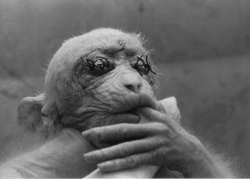 Chimpanzees inside SEMA, a federally-funded laboratory
located in Silver Spring, Maryland, went insane after spending years in isolation chambers
that allowed nothing but the continual hum of the air filtration system to reach them.
After viewing a tape made by animal rights activists (now called Breaking Barriers and
available through PETA), Dr. Jane Goodall, the foremost authority on chimps, visited SEMA
in March 1987. Here is what she said: "Even the repeated viewing of the video did not
prepare me for the stark reality of that laboratory. I was ushered by white-coated men who
smiled nervously or glowered, into a nightmare world. Outside, everyday life went on as
usual, with the sun and the trees and the birds. Inside, where no daylight had ever
penetrated, it was dim and colorless. I looked into room after room lined with small, bare
cages, stacked one above the other. I watched as monkeys paced around their tiny prisons,
making bizarre abnormal movements... chimp babies peered out from the semi-darkness of
their tiny cells... I am still haunted by their eyes, and the eyes of the other chimps I
saw that day. They were dull and blank, like the eyes of people who have lost all
hope..." In a notarized statement, she declared conditions at SEMA to be
"totally unacceptable." (from Visions of Caliban by Dr. Jane Goodall)
Chimpanzees inside SEMA, a federally-funded laboratory
located in Silver Spring, Maryland, went insane after spending years in isolation chambers
that allowed nothing but the continual hum of the air filtration system to reach them.
After viewing a tape made by animal rights activists (now called Breaking Barriers and
available through PETA), Dr. Jane Goodall, the foremost authority on chimps, visited SEMA
in March 1987. Here is what she said: "Even the repeated viewing of the video did not
prepare me for the stark reality of that laboratory. I was ushered by white-coated men who
smiled nervously or glowered, into a nightmare world. Outside, everyday life went on as
usual, with the sun and the trees and the birds. Inside, where no daylight had ever
penetrated, it was dim and colorless. I looked into room after room lined with small, bare
cages, stacked one above the other. I watched as monkeys paced around their tiny prisons,
making bizarre abnormal movements... chimp babies peered out from the semi-darkness of
their tiny cells... I am still haunted by their eyes, and the eyes of the other chimps I
saw that day. They were dull and blank, like the eyes of people who have lost all
hope..." In a notarized statement, she declared conditions at SEMA to be
"totally unacceptable." (from Visions of Caliban by Dr. Jane Goodall)
Conscious baboons at the University of
Pennsylvania were tormented and mocked by researchers after being disabled by blows to
their heads. Following an expose by People for the Ethical Treatment of Animals (PETA) in
1985, USDA inspectors found 74 violations of minimal care standards. Here, vivisectors
smashed primates' heads in simulated car crash tests. Baboons' heads were cemented into
metal helmets connected to a hydraulic device which thrusted their heads at 60 degree
angles with a force of 1,000 gravities. A video of the experimenters was stolen (now
called Unnecessary Fuss -- what one of the vivisectors said about the protests after PETA
aired the video). In this tape, an experimenter said, "you'd better hope the
anti-vivisection people don't get this film," which showed an experiment on a primate
in progress with the animal taped to the exam table. Penn was found guilty of failing to
perform sterile surgery -- one person was smoking, instruments that had been dropped on
the floor were picked up and used inside the animals' head, and proper surgical dress was
not enforced. After seeing the tape, 16 United States representatives wrote to the
Secretary of Health and Human Services and said they should no longer get funding due to
terrible conditions.
The Animal Welfare Act, which was
enacted in 1965 and been amended three times since, covers a very small fraction of
animals experimented on in the U.S.
The Animal Welfare Act is the federal
law governing the humane care, handling, treatment and transportation of animals used in
labs. It does not, however, prohibit any experiment, no matter how painful or useless. The
act also covers dealers who sell animals to labs. There are no regulations whatsoever that
specifically govern the conduct of an experiment or what the animals will be forced to
endure during an experiment. For example, the Act allows the withholding of anesthesia
whenever "scientifically necessary," which means that if an experimenter thinks
anesthesia will interfere with the results of the experiment, then the animal is not given
any, no matter how painful the test will be. Basically, all the Act does is state that a
cage must be large enough for an animal to make "normal postural adjustments,"
which vary from species to species. Adult primates may still be confined to cages that
allow them only enough space to stand upright and lie down. In most labs, no effort is
made to allow touching, social grooming, or other social contact vital to primates, and
rarely are any objects or amusements provided to help pass the time of our intelligent
relatives in the animal kingdom. (If you believe you have witnessed violations of the AWA,
please write to the Deputy Administrator, USDA, APHIS, REAC, Federal Building, 6505
Belcrest Rd., Rm. 208, Hyattsville, MD 20789.)
The U.S. Military inflicts the pains of
war on hundreds of thousands of animals each year in experiments. The Department of
Defense (DOD) and the Veterans Administration (VA) together are the federal government's
second largest user of animals (after the National Institutes of Health). They account for
nearly half the estimated minimum of 1.6 million dogs, cats, guinea pigs, hamsters,
rabbits, primates, rats, mice, and "wild animals" used. Other use of animals in
military experiments is suspected, but such information is kept secret and is hard to
verify.
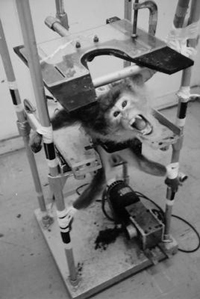 At the Armed Forces Radiobiology Research Institute in
Maryland, nine rhesus monkeys were strapped in chairs and exposed to total-body
irradiation experiments, which are classified as among the most painful types of animal
research. The animals suffer from internal bleeding, violent nausea, severe dehydration,
starvation, pneumonia, liver and kidney failure, and the deliberate injuries that their
"caretakers" inflict on them. Within two hours, six of the nine were vomiting,
hypersalivating, and chewing. At Brooks Air Force Base in Texas, rhesus monkeys were
strapped to a B-52 flight simulator. After being prodded with painful electric shocks to
learn to "fly" the device, the monkeys were irradiated with gamma rays to see if
they could hold out "for the 10 hours it would take to bomb an imaginary
Moscow." Those hit with the heaviest doses vomited violently and became extremely
lethargic before dying. To evaluate the effect of temperature on the transmission of the
Dengue 2 virus, a mosquito-transmitted disease that causes fever, muscle pain, and rash,
experiments conducted by the U.S. Army at Fort Detrick, MD, involved shaving the stomachs
of adult rhesus monkeys and then attaching cartons of mosquitoes to their bodies to allow
the mosquitoes to feed.
At the Armed Forces Radiobiology Research Institute in
Maryland, nine rhesus monkeys were strapped in chairs and exposed to total-body
irradiation experiments, which are classified as among the most painful types of animal
research. The animals suffer from internal bleeding, violent nausea, severe dehydration,
starvation, pneumonia, liver and kidney failure, and the deliberate injuries that their
"caretakers" inflict on them. Within two hours, six of the nine were vomiting,
hypersalivating, and chewing. At Brooks Air Force Base in Texas, rhesus monkeys were
strapped to a B-52 flight simulator. After being prodded with painful electric shocks to
learn to "fly" the device, the monkeys were irradiated with gamma rays to see if
they could hold out "for the 10 hours it would take to bomb an imaginary
Moscow." Those hit with the heaviest doses vomited violently and became extremely
lethargic before dying. To evaluate the effect of temperature on the transmission of the
Dengue 2 virus, a mosquito-transmitted disease that causes fever, muscle pain, and rash,
experiments conducted by the U.S. Army at Fort Detrick, MD, involved shaving the stomachs
of adult rhesus monkeys and then attaching cartons of mosquitoes to their bodies to allow
the mosquitoes to feed.
Many laboratory libraries contain
evidence that painful experiments have been repeated over and over on animals for decades.
For example, from 1975 through 1982, more than 38,000 experiments, all dealing with cancer
caused by radiation, were conducted on animals.
NASA's $33.2 million joint
U.S./French/Russian Bion 11 and 12 experiments force monkeys to suffer through agonizing,
invasive procedures. Fourteen electrode wires sunk into seven muscles in the monkeys' arms
and legs tunnel under their skin and exit from a hole carved in their backs. More
electrodes are inserted into the monkeys' brains -- their exposed skulls are covered with
metal caps and eight holes are drilled into their skulls to accommodate a plastic
"halo" so they cannot move their heads. Wires from a surgically buried
thermometer in each animal's abdomen exit yet another hole cut in their backs. Many
monkeys have mutilated themselves trying to rip the wires out from under their skin,
despite the fact that NASA experimenters bind the animals in straitjackets. After
undergoing these painful surgeries, the monkeys are blasted into space for 14 days. During
the two-week orbit, the monkeys are completely restrained, obtaining food from a
"sipper tube." NASA claimed the Bion experiments would help study the effects of
weightlessness on human astronauts, yet NASA already has data on human beings who have
spent more than 400 days in space at one time. NASA launched the monkeys in an antiquated
Russian capsule not even equipped to properly record data. If something went wrong in
space, there was no one to help the monkeys. The instrumented monkeys were launched from
Russia on Christmas Eve 1996. They landed in freezing temperatures in Kazakhstan on
January 7, 1997. One day later, Multik, one of the Bion monkeys, died before he could be
subjected to further experiments.
A February 1996 Bion Science Assessment
Report criticized the project for its lack of "scientific leadership" and its
failure to consider less cruel methods for obtaining data and cited many other examples of
Bion's scientific failings, including repetitive and irrelevant tests. Thanks to the
ceaseless efforts of animal rights activists, on April 22, 1997, NASA formally announced
the end of its involvement in the cruel Bion project.
Chimpanzees are more closely related to
humans than they are to gorillas. Chimpanzees are highly intelligent, probably more so
than human-based tests are able to measure. They make and use tools, cooperate with and
learn from each other, and can learn various forms of expression and communication,
including American Sign Language and computer symbols. Chimpanzees also have good
memories. However, fewer than 250,000 chimpanzees still exist in western and central
Africa. Chimpanzee habitats, already small and isolated, are being further destroyed by
increased commercial and agricultural development. Both species of African chimpanzee are
considered endangered. Though the U.S. Department of the Interior also lists them as
endangered, there are approximately 2,000 captive chimpanzees in the United States. About
300 are in zoos; the remaining 1,700 were bred for medical research. Many are the
offspring of chimpanzees captured in the wild before 1973, when the United States agreed
to abide by an international treaty prohibiting the capture and import of wild
chimpanzees. Unwanted chimpanzees from zoos and circuses are sometimes sold to
laboratories. Chimpanzees are still captured in the wild by poachers who shoot chimpanzee
mothers and then take their infants, but many of those baby chimpanzees die before they
reach a laboratory. Because adults protect the infants, several adults are sometimes
killed to obtain one baby.
Chimpanzees are now popular subjects
for AIDS research, although their immune system does not succumb to the virus. Chimpanzees
are also used in painful cancer, hepatitis, and psychological tests, as well as for
research into artificial insemination and birth control methods, blood diseases, organ
transplants, and experimental surgery. Because they are in short supply, captive chimps
are often subjected to multiple experiments, each of which can last an average of two to
four years. Since adult chimpanzees are strong and often unmanageable, and infected
chimpanzees cannot be placed in zoos or existing sanctuaries, many chimpanzees are killed
before the age of 10. The normal lifespan of a chimpanzee is 40 to 50 years. Others,
perhaps not as lucky, are kept in tiny cages for decades at such places as Buckshire
Corp., a USDA-licensed animal dealer exposed by PETA in 1994 for housing 42 chimpanzees in
substandard cages.
During the late 1980s, the National
Institutes of Health (NIH) developed its so-called "National Chimpanzee Management
Plan." This plan is, in reality, just a funding mechanism for five breeding colonies
to maintain a steady supply of chimpanzees for vivisectors. Under a series of grants, the
plan established breeding colonies of chimps at the Yerkes Regional Primate Research
Center in Atlanta, the University of Texas, the Primate Foundation of Arizona in Tempe,
the University of Southwestern Louisiana in New Iberia, and New Mexico State University
(NMSU) in Alamogordo. In 1993, NMSU's chimpanzee colony passed into the hands of the
Coulston Foundation, a facility that now cages more than 500 chimpanzees. Coulston owner
Frederick Coulston, refers to himself as the "father of toxicology" and promotes
the use of other-than-human primates in archaic, painful toxicology tests. He refers to
chimpanzees as "vicious, aggressive animals" and, in an interview with The
Boston Globe, admitted to spraying chemicals into the open eyes of monkeys at Coulston,
which gets most of its funding from NIH.
The Chimpanzee Management Plan (CMP)
costs $1.5 million a year just to maintain the chimps, and many millions more to staff and
operate. The initial budget request for CMP-related grants was rejected by Congress in
1986. CMP programs are now being funded by NIH with $4.5 million taken from the existing
AIDS research budget.
Current CMP guidelines do not prohibit
any potentially painful or psychologically damaging experiment from being performed on
chimpanzees, nor do they establish minimum housing standards. The plan has no provision
for retiring old or "worn out" chimps, nor does it require that infant chimps be
raised by their mothers. Two-thirds of the chimps raised under the CMP are released to
research projects. The rest are used for breeding.
The National Institutes of Health is
now considering giving $3.3 million to Columbia Presbyterian Hospital in New York to breed
chimps who would be killed to provide hearts and other organs for human transplants. Each
transplanted chimp heart would be used only until a human heart became available. No
chimp-to-human heart transplant has yet been successful.
Using monkeys as surrogate humans is
never good science; confinement is unnatural to the species, and the stress of capture,
shipping, caging, and experimentation compromises their immune systems, and leads to
psychological deterioration and neuroses, not to mention it's incredibly cruel.
When news reports tally the casualties
of war, or when monuments are erected to honor soldiers, the other-than-human victims of
war -- the animals whose bodies are shot, burned, poisoned, and otherwise tortured in
tests to create even more ways to kill people -- are never recognized, nor is their
suffering well known. The 1987 movie Project X offered only a glimpse of the kind of
experiments that go on far from public view but at taxpayer expense.
---------------------------
For more information or to become a
"whistleblower" on animal cruelty, call PETA's RIR department at 757-622-PETA,
or e-mail at peta2@norfolk.infi.net . Or write
to your representatives in Congress and ask they support any pending or future legislation
that strengthens the USDA's ability to enforce the AWA.
Jennifer Winston is a former employee
of PETA, In Defense of Animals, the Wildlife Care Center, The Humane Society of Broward
County, and The New England Anti-Vivisection Society. She is currently the host of an
animal rights TV show, "For the Animals".
Information for this article was
provided by People for the Ethical Treatment of Animals, 501 Front St., Norfolk, VA 23510

