Tiny spinning screws that could ferry drugs along veins or even burrow into tumours, are revealed.
A team of micromachine experts have developed tiny spinning screws that could swim along veins, ferrying drugs to infected tissues, or even burrow into tumours to kill them off with a hot lance.
Kazushi Ishiyama at Tohoku University in Japan has designed swimming micromachines based on cylindrical magnets. Measuring eight millimetres long and less than a millimetre in diameter, each magnet is made of a neodymium-iron-boron alloy.
Ishiyama made two prototypes to test his idea. The first was designed to move in liquids and had a short section of ceramic pipe attached to each end of the magnet . A wire wound around the pipe's surface gave it a screw-like thread.
To test the device, Ishiyama immersed it in a container of silicone oil, which was fixed between two vertical coils of wire. By pumping alternating current through the coils, Ishiyama produced a rotating magnetic field around the container, which set the screw spinning. Because of its threaded surface, the screw slowly began to cut through the oil. Its speed increased as the frequency of the rotating magnetic field was ramped up.
Burrowing in
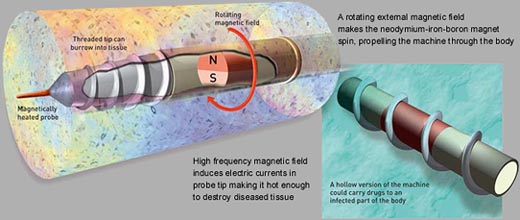 Ishiyama's second prototype, designed to swim and burrow into tissue, used a
similar magnet but instead had a pointed, threaded brass tip at one end.
Ishiyama's second prototype, designed to swim and burrow into tissue, used a
similar magnet but instead had a pointed, threaded brass tip at one end.
This time, Ishiyama tested the device in liquids thicker than oil. He found that it could move at nearly two centimetres per second in a thick agar gel. Again, the device moved faster the quicker the magnetic field was rotated, up to a maximum of 20 hertz.
Above this frequency, the magnet stopped spinning and ground to a halt. After the gel tests, Ishiyama decided to see how well the device could burrow through real tissue. He found it could screw itself through a two-centimetre thick chunk of beef steak in 20 seconds.
Because the devices are so small, Ishiyama says they could be injected into the body using standard hypodermic needles. Once inside a vein, they could be steered around the body magnetically. "Using a 3D magnetic field supply system and controller, we can steer the machine in any direction," he says.
Hot spike
Inside the body, Ishiyama says the devices could carry drugs to the sites of infection. His latest prototype is even armed with a tiny metal spike that heats up when you apply a second magnetic field vibrating at 100 kHz.
The hot spike could be useful for destroying cancerous tissue, Ishiyama believes. The high frequency field used to heat the metal tip doesn't interfere with steering the device, he adds. He plans to show off the latest model in August, at the Joint European Magnetic Symposia in Grenoble.
"The simplicity appeals to me," says Edwin Jager at Linkoping University in Sweden, who is designing tiny robots to manipulate single cells in the body.
But Jager adds that surgeons are understandably cautious about the idea of microbots floating free in the body. If one blocked a blood vessel, for example, it could be disastrous. He also says that Ishiyama's prototypes might be too long to safely navigate some of the tighter turns in blood vessels.
While Ishiyama concedes that his swimming machines won't replace standard tools such as catheters for medical operations any time soon, he thinks that nanobots even smaller than this could have a distinct advantage. "If our machines become smaller than catheters, they could be used for treatment in very thin blood vessels, like in the brain," he says.

